From the Mountains of Gunayala to the Free Land Camp in Brazil
Iniquilipi Chiari Lombardo (Gunayala, Panama) is a Guna activist, communicator and founder of TV Indígena, an all-Indigenous TV network based in Panama founded in 2017, with a unique approach to storytelling and the impact of technology on Indigenous communities. He works to defend Indigenous rights, land stewardship, and the environment, being a key voice in advocacy efforts, often collaborating with organizations and other international leaders to push for direct and sustainable funding for Indigenous-led conservation.
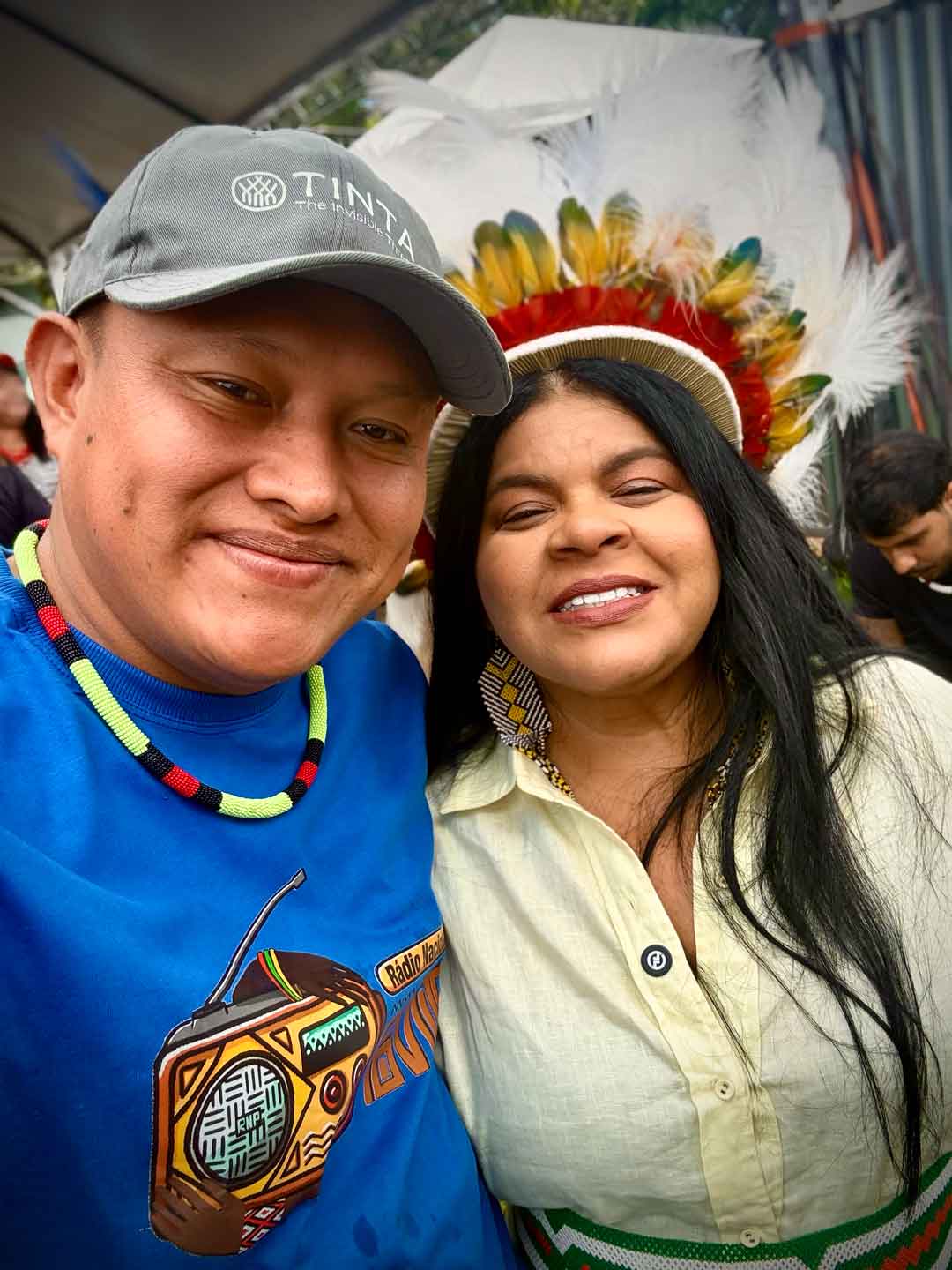
In this feature, Iniquilipi reflects on what it means to cross mountains and oceans to stand in solidarity with the Indigenous struggle in Brazil, and why the Acampamento Terra Livre remains one of the most powerful movements in the world.
It was 2023, my first time in Brazil
invited by If Not Us Then Who?, and there I was, a communicator from TV Indígena, taking part in the Acampamento Terra Livre (ATL), where some 10,000 Indigenous People s from hundreds of different nations gathered with their delegations, full of energy, dancing from morning until night. I had only heard stories from my cousin Olo Villalaz, seen it in videos and photos.
This Guna, now, was witnessing one of the greatest Indigenous Peoples’ movements in the world.
It was a unique moment, seeing so many brothers and sisters from every region of Brazil, from the Amazon to the South, learning about their struggles, sharing their dreams, over several days, especially during the march, together calling out for Mother Earth. I’ll admit that at that time my Portuguese was nonexistent, just an obrigado and a smile.
No matter how much I had shared with my brothers and sisters, I kept asking myself the same question: what is a brother from other mountains doing here, in a country that does not speak his language? What does it mean for a Guna, a stranger from other mountains, to stand alongside the Indigenous struggle of Brazil?

Açaí, Rapé, and Beijú with Grilled Fish
On that first trip I discovered açaí, the famous fruit of the Brazilian forests. I also had the chance to experience rapé for the first time, a traditional medicine of the Indigenous Peoples of the Amazon basin.
I still remember the feeling after participating in the march: it was as if I was connecting with the forest in the middle of the city. I also met many territorial leaders and communicators, shared crispy Beijú with grilled fish, which became my favorite food in Brazil, and shared in the songs of the Guaraní brothers, with the melodies of their guitars and violins.


On that trip, I met the crew from Mídia Índia (as they were called at the time), a collective of young photographers and filmmakers, and we arrived as TV Indígena. Today, they’ve updated their name to Mídia Indígena.

I also reconnected with friends like Luana Kaingang, who today is one of the leaders of the Articulation of Indigenous Peoples of Brazil (APIB), as coordinator of the Articulation of Indigenous Peoples of the Southern Region (ARPINSUL).
We made our first interviews, our first collaborations with Mídia Indígena, a relationship we’ve kept to this day. That first trip was like planting a seed in someone else’s soil, but that seed has grown into a tree that now blooms and welcomes much life.
The ATL planted in me an urgency to make the region’s demarcations visible, to share their struggles through TV Indígena, and to carry them to other countries of Abya Yala.
I had the opportunity to share space alongside leader Sonia Guajajara, and to see her at the ATL as the first Minister of the Ministry of Indigenous Peoples of Brazil. And alongside sister Célia Xakriabá, the first Indigenous woman elected as a Deputy for the state of Minas Gerais. Their struggles and dreams within the political arena are so necessary for changing the legal frameworks of Brazil, frameworks that are so often created against Indigenous peoples.
TV Indígena: Nine Years of Walking Together
Today, nine years since it was founded, TV Indígena walks alongside global leaders, from the islands of Indonesia, traveling with leaders of the Congo River Basin, to the leaders of the Amazon and all of Abya Yala, doing live coverage, making territorial struggles visible, visiting territories, documenting their challenges, and also seeking allies and donors so we can keep telling our own stories.

Returning as Family
Today, in 2026, I return no longer as a stranger, but as family, as a brother. I also have nieces and nephews who have been born during these years of struggle. Watching them run and play, others just newborns, barely 3 months old, already in the march alongside their parents.
This year, the Brazilian people face a test in the general elections, which also means a struggle in the Chamber of Deputies, where laws are written that so often impact territories already demarcated or yet to be demarcated.

The ATL takes on an even more relevant role, uniting territories, movements, and Indigenous struggles. I’ve also seen how bonds form between territories, serving as an example for Indigenous Peoples around the world.

This year, the ATL celebrated its 22nd edition. It has not been easy for APIB to organize something this large for so long, the unity of regional organizations has been key. For other Indigenous Peoples of the world, Brazil’s ATL is a model.
I must mention the essential role played by global allies and donors, to keep investing in standing forests, and that also means supporting those who protect them: Indigenous Peoples.


Let’s March Together
I dream of more ATLs. I dream that leaders from other countries can come and see in person how my Brazilian brothers and sisters fight.
I invite everyone to come to the next ATL in 2027. Let’s march together with the Indigenous peoples of Brazil, let’s shake the maracas, share our dances. I can guarantee it is a life-changing experience, for the moments you live and the people you meet.
If you are not from Brazil and you know about the ATL, it is likely because, just like TV Indígena, we have done our work, and this is just the beginning of our relationship with Brazil.
Every time I return to Panama, my bags are filled with invitations from all my friends, with the promise of visiting them at some point in my life. Our roots now travel over great mountains, cross oceans, all the way back to Panama.


Iniquilipi Chiari Lombardo
Panama | Gunayala
Indigenous activist, communicator and founder of TV Indígena
Follow Iniquilipi: Instagram | LinkedIn
For press moments, speaking opportunities & other inquiries please contact: [email protected]